
Estructura y función de la fauna bentónica en el Corredor Arrecifal del Suroeste del Golfo de México
Barra lateral del artículo
Contenido principal del artículo
Resumen
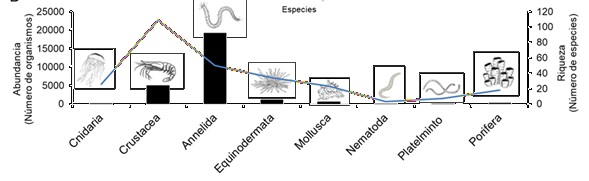
El Corredor Arrecifal del Suroeste del Golfo de México (CASGM) es un sistema de alta relevancia ecológica, instancias gubernamentales (e.g. CONABIO) dispone de información histórica sobre la fauna bentónica; sin embargo, estos datos están dispersos y carecen de un tratamiento analítico que facilite su uso en la toma de decisiones. Este estudio analizó dicho acervo (1994-2020) para identificar la sensibilidad y tolerancia de las especies bentónicas del CASGM. Se utilizó un índice de diversidad beta para identificar qué especies explican la variación entre comunidades bentónicas. Posteriormente, dichas especies se clasificaron en cinco grupos ecológicos según su nivel de sensibilidad y tolerancia ante el disturbio. La mayoría de los registros se concentraron en las regiones norte y centro, mientras que el sur fue poco explorado. Especies de crustáceos, equinodermos y poliquetos mostraron la mayor variabilidad espacial, siendo claves en la diferenciación de comunidades. Predominaron especies sensitivas e indiferentes en el norte y centro, reflejando resiliencia, aunque se registraron especies tolerantes y oportunistas en zonas costeras expuestas a presiones antrópicas. En el sur, dominaron especies tolerantes y oportunistas, posiblemente influenciadas por descargas fluviales, enriquecimiento orgánico y actividad portuaria-petroquímica. Este enfoque subraya la importancia de integrar información histórica para la gestión del CASGM.
Detalles del artículo

Esta obra está bajo una licencia internacional Creative Commons Atribución-NoComercial-CompartirIgual 4.0.
De acuerdo con la licencia Creative Commons ATRIBUCIÓN-NOCOMERCIAL-COMPARTIRIGUAL 4.0 INTERNACIONAL, establece que:
Usted es libre de:
- Compartir : copiar y redistribuir el material en cualquier medio o formato.
- Adaptar : remezclar, transformar y construir a partir del material
- El licenciante no puede revocar estas libertades siempre y cuando usted cumpla con los términos de la licencia.
En los siguientes términos:
- Atribución — Debe dar el crédito adecuado , proporcionar un enlace a la licencia e indicar si se realizaron cambios . Puede hacerlo de cualquier manera razonable, pero no de ninguna manera que sugiera que el licenciante lo respalda a usted o a su uso.
- No comercial — No puede utilizar el material con fines comerciales .
- CompartirIgual : si remezclas, transformas o construyes a partir del material, debes distribuir tus contribuciones bajo la misma licencia que el original.
- Sin restricciones adicionales : no puede aplicar términos legales o medidas tecnológicas que restrinjan legalmente a otros de hacer cualquier cosa que permita la licencia.

Avisos:
No tiene que cumplir con la licencia para los elementos del material en el dominio público o donde su uso esté permitido por una excepción o limitación aplicable.
No se ofrecen garantías. Es posible que la licencia no le otorgue todos los permisos necesarios para el uso previsto. Por ejemplo, otros derechos, como la publicidad, la privacidad o los derechos morales, pueden limitar la forma en que utiliza el material.
Citas
Borcard, D., Gillet, F., & Legendre, P. (2011). Numerical ecology with R (Vol. 2, 688 p.). Springer.
Borja, A., Franco, J., & Pérez, V. (2000). A marine biotic index to establish the ecological quality of soft-bottom benthos with European estuarine and coastal environments. Marine Pollution Bulletin, 40, 1100–1114. https://doi.org/10.1016/S0025-326X(00)00061-8
Borja, A., Marín, S. L., Muxika, I., Pino, L., & Rodríguez, J. G. (2015). Is there a possibility of ranking benthic quality assessment indices to select the most responsive to different human pressures? Marine Pollution Bulletin, 97(1–2), 85–94. https://doi.org/10.1016/j.marpolbul.2015.06.030
Borja, A., Chust, G., & Muxika, I. (2019). Forever young: The successful story of a marine biotic index. Advances in Marine Biology, 82, 93–127. https://doi.org/10.1016/bs.amb.2019.05.001
Borja, A., Adarraga, I., Bald, J., Belzunce-Segarra, M. J., Cruz, I., Franco, J., ... & Muxika, I. (2025). Marine biodiversity and environmental data: An AI-ready, open dataset from the long term (1995–2023) Basque Country monitoring network. Frontiers in Ocean Sustainability, 2, 1528837. https://doi.org/10.3389/focsu.2024.1528837
Castañeda-Chávez, M., Navarrete-Rodríguez, G., & Lango-Reynoso, F. (2025). Fuentes puntuales de contaminación de la zona costera adyacente al PNSAV (pp. 207–226). En A. Granados-Barba, L. D. Ortiz-Lozano, & A. L. Gutiérrez-Velázquez (Eds.), Nuevo conocimiento sobre el corredor arrecifal del suroeste del Golfo de México: Integrando los ambientes costeros. EPOMEX-UAC eBooks. https://doi.org/10.26359/epomex02202508
Comisión Nacional para el Conocimiento y Uso de la Biodiversidad [CONABIO]. (2023). Catálogo de autoridades taxonómicas de especies de flora y fauna con distribución en México. Base de datos SNIB-CONABIO.
Dray, S., Bauman, D., Blanchet, G., Borcard, D., Clappe, S., & Guenard, G. (2012). Multivariate multiscale spatial analysis (R package version 0.0-3). https://cran.r-project.org/package=adespatial
Giere, O., & Schratzberger, M. (2023). New horizons in meiobenthos research: Profiles, patterns, and potentials. Springer. https://doi.org/10.1007/978-3-031-21622-0
Jordán-Garza, A. G., González-Gándara, C., Salas-Pérez, J. J., & Morales-Barragán, A. M. (2017). Coral assemblages are structured along a turbidity gradient on the southwestern Gulf of Mexico, Veracruz. Continental Shelf Research, 138, 32–40. https://doi.org/10.1016/j.csr.2017.03.002
Legendre, P. (2014). Interpreting the replacement and richness difference components of beta diversity. Global Ecology and Biogeography, 23, 1324–1334. https://doi.org/10.1111/geb.12207
Martínez-Esponda, F. X., Escorcia-Quintana, M., García-Maning, G., & Ramos-Pedrueza, X. (2021). Los factores de presión al Sistema Arrecifal Lobos Tuxpán (SALT), Sistema Arrecifal Veracruzano (SAV) y Sistema Arrecifal de los Tuxtlas (SAT) (pp. 60–78). En L. Ortiz-Lozano, F. X. Martínez-Esponda, & L. Hensler (Eds.), El corredor arrecifal del suroeste del Golfo de México: Retos y oportunidades para su protección y manejo (p. 427). Centro Mexicano de Derecho Ambiental A.C.
Mendoza-González, G., Martínez, M. L., Guevara, R., Pérez-Maqueo, O., Garza-Lagler, M. C., & Howard, A. (2018). Towards a sustainable sun, sea, and sand tourism: The value of ocean view and proximity to the coast. Sustainability, 10(4), 1012. https://doi.org/10.3390/su10041012
Ortiz-Lozano, L., Pérez-España, H., Granados-Barba, A., González-Gándara, C., Gutiérrez-Velázquez, A. L., & Martos, J. (2013). The reef corridor of the southwest Gulf of Mexico: Challenges for its management and conservation. Ocean & Coastal Management, 86, 22–32. https://doi.org/10.1016/j.ocecoaman.2013.10.006
Ortiz-Lozano, L., Colmenares-Campos, C., & Gutiérrez-Velázquez, A. (2018). Submerged coral reefs in the Veracruz Reef System, Mexico, and its implications for marine protected area management. Ocean & Coastal Management, 158, 11–23. https://doi.org/10.1016/j.ocecoaman.2018.03.012
Ortiz-Lozano, L., Gutiérrez-Velázquez, A., Aja-Arteaga, A., Argüelles-Jiménez, J., & Ramos-Castillo, V. (2021). Distribution, threats, and management of submerged reefs in the north of the reef corridor of the southwest Gulf of Mexico. Ocean & Coastal Management, 201, 105428. https://doi.org/10.1016/j.ocecoaman.2020.105428
Pérez-Rojas, A., Torres-Orozco, R. B., Morales-Gutiérrez, E., & Pérez-Méndez, E. (2000). Textura, composición y contenido de materia orgánica de los sedimentos recientes de un lago tropical de México. Hidrobiológica, 10(1), 41–50. https://www.scielo.org.mx/scielo.php?script=sci_arttext&pid=S0188-88972000000100006
R Development Core Team. (2022). R: A language and environment of statistical computing (Version 4.2.2). R Foundation for Statistical Computing. https://www.R-project.org/
Raymond, C. (2022). Ecological succession of benthic macrofauna following disturbance: Effects of contaminants and in situ sediment remediation [Tesis doctoral, Stockholm University].
Ruiz-Fernández, A. C., Betancourt-Portela, J. M., Sericano, J. L., Sanchez-Cabeza, J. A., Espinosa, L. F., Cardoso-Mohedano, J. G., Pérez-Bernal, L. H., & Garay-Tinoco, J. A. (2016). Coexisting sea-based and land-based sources of contamination by PAHs in the continental shelf sediments of Coatzacoalcos River discharge area (Gulf of Mexico). Chemosphere, 144, 591–598. https://doi.org/10.1016/j.chemosphere.2015.09.027
Santander-Monsalvo, J., Espejel, I., & Ortiz-Lozano, L. (2018). Distribution, uses, and anthropic pressures on reef ecosystems of Mexico. Ocean & Coastal Management, 165, 39–51. https://doi.org/10.1016/j.ocecoaman.2018.08.011
Santibañez-Aguascalientes, N. A., Borja, A., & Ardisson, P.-L. (2023a). Assessing the large-scale and long-term changes in the southern Gulf of Mexico benthic ecological status under natural and human-induced disturbances. Estuarine, Coastal and Shelf Science, 283, 108282. https://doi.org/10.1016/j.ecss.2023.108282
Santibañez-Aguascalientes, N. A., Ortiz-Lozano, L. D., & Gutiérrez-Velázquez, A. L. (2023b). Arrecifes sumergidos en Veracruz: Nuevos retos de conservación. Avance y Perspectiva (CINVESTAV). https://avanceyperspectiva.cinvestav.mx/arrecifes-sumergidos-en-veracruz-nuevos-retos-de-conservacion/
Schwing, P. T., Montagna, P. A., Joye, S. B., Paris, C. B., Cordes, E. E., McClain, C. R., Kilborn, J. P., & Murawski, S. A. (2020). A synthesis of deep benthic faunal impacts and resilience following the Deepwater Horizon oil spill. Frontiers in Marine Science, 7, 560012. https://doi.org/10.3389/fmars.2020.560012